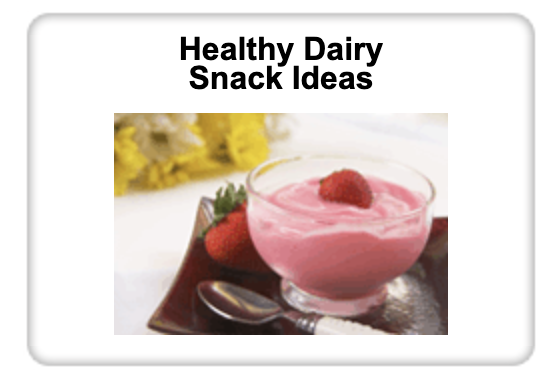
Healthy Dairy Snack Ideas String Cheese and Fruit Low fat or nonfat Milk or Yogurt Smoothies with 100% fruit juice and sliced bananas or strawberries Cottage Cheese or Yogurt with fruit (fresh or canned) Fat-Free or 1% White, Chocolate or Flavored Milk
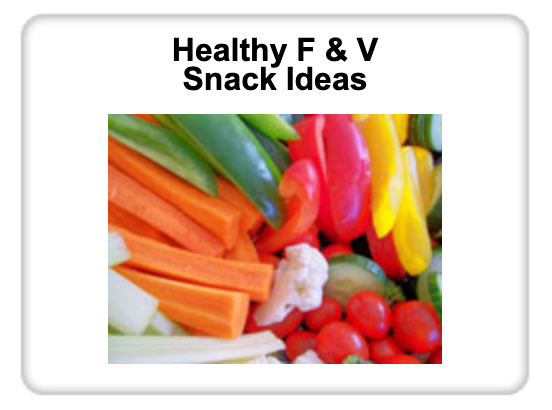
Healthy Fruit and Veggie Snack Ideas Raw Vegetables with low-fat yogurt dip, cottage cheese or humus Baby Carrots Celery Sticks Cucumber Slices Apples and cheese - pears and other fruits are good too! Frozen fruit bars Trail mix with nuts and dried fruit 100% Fruit Juice box
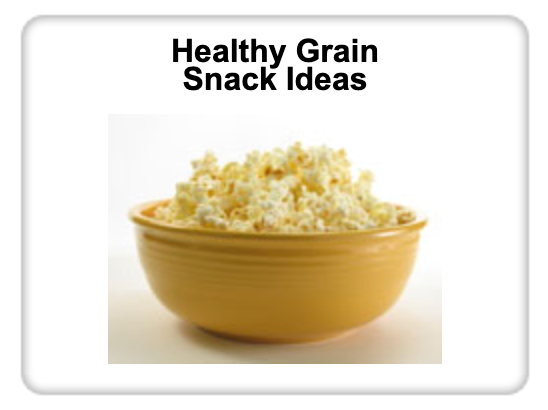
Healthy Grain Snack Ideas Whole-grain crackers with cheese or peanut butter Whole-grain cereal with milk Flavored rice cakes (like caramel or apple cinnamon) with peanut butter Baked potato chips, or tortilla chips with salsa Popcorn - Air popped or low-fat microwave Pretzel sticks and a glass of milk Vanilla wafers, gingersnaps, graham crackers, animal crackers, fig bar or raisins, and a glass of milk
Smart Snacks in School
We are focused on the health of our school environment. Our school district has established nutrition standards for all snacks sold in school by any entity, including parent/student organizations, teachers, boosters, fundraisers, or the food and nutrition services department. These standards for snack sales are in effect from any time before school through 1/2 hour after school, in accordance with the Healthy Hunger-Free Kids Act, the USDA, and our district Wellness Policy. Non-compliant foods may be sold from 1/2 hour after school through the end of the day. These standards carefully balance science-based nutrition guidelines with practical and flexible solutions to promote healthier eating on campus.
Healthy Snack Calculators
Is Your Snack a Smart Snack? Use the Smart Snacks Product Calculator, developed by the Alliance for a Healthier Generation, to take the guesswork out of nutrition guidelines! Simply enter the product information, answer a few questions, and determine whether your snack, side, or entree item meets the new USDA Smart Snacks in School Guidelines.
Kids often need snacks to help them get enough calories (ENERGY) throughout the day. Choosing healthy snacks that add nutrients, like vitamins and minerals, to their diets is essential. Smart snacking is a great way to meet daily nutrient requirements that may be missed at meal times.
Students in our district are offered healthier school meals with more fruits, vegetables, and whole grains through the National School Lunch and Breakfast Program. The Smart Snacks in School standards published by the USDA will build on those healthy advancements by ensuring that all other snack foods and beverages available for sale to students in school are tasty and nutritious.
Nutrition Standards for Foods
Any food sold in school must:
Be a “whole grain-rich” grain product; or
Have as the first ingredient a fruit, a vegetable, a dairy product or a protein food; or
Be a combination food that contains at least ¼ cup of fruit and/or vegetable; or
Contain 10% of the Daily Value (DV) of one of the nutrients of public health concern in the 2010 Dietary Guidelines for Americans (calcium, potassium, vitamin D, or dietary fiber)
Foods must also meet several nutrient requirements:
Calorie limits
Snack items: ≤ 200 calories
Entrée items: ≤ 350 calories
Sodium limits
Snack items: ≤ 230 mg
Entrée items: ≤ 480 mg
Fat limits
Total fat: ≤ 35% of calories
Saturated fat: ≤ 10% of calories
Trans fat: zero grams
Sugar limit ≤ 35% of weight from total sugars in foods
Accompaniments
Accompaniments such as cream cheese, salad dressing, and butter must be included in the nutrient profile as part of the food item sold. This helps control the amount of calories, fat, sugar and sodium added to foods.
Nutrient Standards for Beverages
All schools may sell:
Plain water (with or without carbonation)
Unflavored low-fat milk
Unflavored or flavored fat-free milk and milk alternatives permitted by NSLP/SBP
100% fruit or vegetable juice, and 100% fruit or vegetable juice diluted with water (with or without carbonation) and no added sweeteners
Elementary schools may sell up to 8-ounce portions, while middle and high schools may sell up to 12-ounce portions of milk and juice. There is no portion size limit for plain water.
Beyond this, the standards allow additional “no calorie” and “lower calorie” beverage options for high school students.
No more than 20-ounce portions of calorie-free, flavored water (with or without carbonation); and other flavored and/or carbonated beverages that are labeled to contain < 5 calories per 8 fluid ounces or ≤ 10 calories per 20 fluid ounces.
No more than 12-ounce portions of beverage with ≤ 40 calories per 8 fluid ounces, or ≤ 60 calories per 12 fluid ounces. Healthy Fundraisers
Food items that meet nutrition standards are not limited
The standards do not apply during non-school hours, on weekends, and at off-campus fundraising events
The standards provide a special exemption for infrequent fundraisers that do not meet the nutrition standards. Each State agency is responsible for establishing the number of exempt fundraisers that may be held in schools each year.
Kids in the Kitchen
There are plenty of fun ways to liven up snack time using healthy fruits, vegetables, and cheeses. Kids will love creating and eating fun-to-make snacks with you in the kitchen! Click on the image to the right to watch a video to learn about some fun and healthy snack ideas that you can make with your kids in the kitchen.
Snacking Tips for Parents
Plan ahead and buy healthy snacks when you shop. You will save money and make healthier choices than if you or your kids are buying snacks on the go.
Provide kids with choices and make those choices nutritious.
Pre-portion your child's snacks into small plastic bags to grab on the go.
Combine snacks from at least two food groups to pack more nutrients into your child's diet... it will be more filling and it will hold them over to the next meal.
And remember... space snacks far enough between meals so appetites are not spoiled!
Two Simple Steps to Delicious and Nutritious Snacks
Katie-Jeffery-Lunn, MS, RD, CDN, LDN
Healthy, Fun Snacks and Desserts for the Whole Family
Reyna Franco, MS, RD, CDN
Healthy, Tasty and Creative Snacks for Kids
Katie-Jeffery-Lunn, MS, RD, CDN, LDN
In accordance with Federal law and the U.S. Department of Agriculture (USDA) civil rights regulations and policies, this institution is prohibited from discriminating on the basis of race, color, national origin (including English proficiency), religion, sex, disability, age, marital status, family/parental status, income derived from a public assistance program, political beliefs, reprisal or retaliation for prior civil rights activity in any program or activity conducted or funded by USDA. (Not all prohibited bases apply to all programs)
Program information may be made available in languages other than English. Persons with disabilities who require alternative means of communication for program information (e.g., braille, large print, audiotape, American Sign Language) should contact the responsible State or local Agency that administers the program or contact USDA through the Telecommunications Relay Service at 711 (voice and TTY).
To file a program discrimination complaint, a complainant should complete a Form AD-3027, USDA Program Discrimination Complaint Form, which can be obtained online at https://www.usda.gov/sites/default/files/documents/ad-3027.pdf , from any USDA office, by calling (866) 632-9992, or by writing a letter addressed to USDA. The letter must contain the complainant's name, address, telephone number, and a written description of the alleged discriminatory action in sufficient detail to inform the Office of the Assistant Secretary for Civil Rights (OASCR) about the nature and date of an alleged civil rights violation. The completed AD-3027 form or letter must be submitted to USDA by:
mail:
U.S. Department of Agriculture
Office of the Assistant Secretary for Civil Rights
1400 Independence Avenue, SW
Washington, D.C. 20250-9410; or
email:
Program.Intake@usda.gov
This institution is an equal opportunity provider.